
Utility Locator Training Simulator
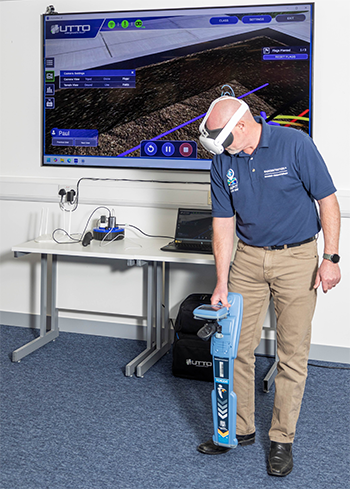
Real-World Utility Locating Training Without the Risk
Train your team faster, safer, and more effectively with a next-generation utility locating training simulator designed to replicate real-world underground conditions, without the cost, risk, or variability of live field training.
In today’s damage prevention environment, accuracy is not optional. It is operationally critical. This training solution allows your team to build real-world locating confidence before stepping onto a live jobsite, reducing costly mistakes and improving long-term performance.
Whether you're onboarding new technicians or refining experienced crews, this simulator gives you a controlled, repeatable environment to build confidence, accuracy, and consistency.
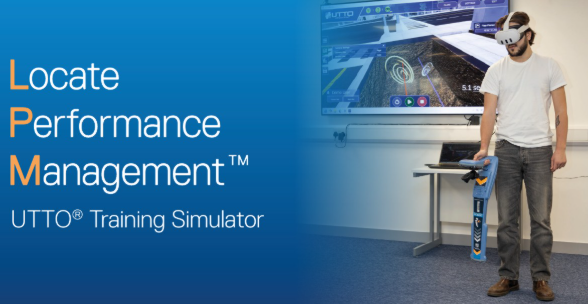
What Is a Utility Locating Training Simulator?
Rather than relying on unpredictable job-site scenarios, a simulator creates a structured environment where technicians can learn, make mistakes, and improve without consequences.
A utility locating training simulator is a mixed-reality or virtual training system that allows technicians to practice locating underground utilities in a safe, simulated environment.
Instead of relying on unpredictable field conditions, the simulator recreates:
Underground pipe & cable layouts
Signal interference scenarios
Complex locating challenges
Real-world electromagnetic responses
These systems combine hardware locators + VR/AR environments to simulate realistic locating conditions and responses.
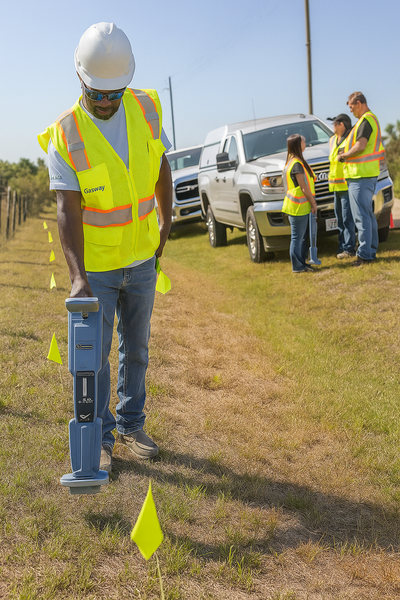
Why Training Simulators Are Becoming Essential
The utility locating industry has evolved rapidly, but training methods have not always kept pace. Many companies still rely heavily on field shadowing or trial-and-error learning, which introduces inconsistency and risk.
As underground infrastructure becomes more congested and as non-metallic utilities become more common, the margin for error continues to shrink. Companies that invest in structured, repeatable training gain a measurable advantage in both performance and safety.
Today’s infrastructure complexity, especially with non-metallic utilities and congested underground environments, demands:
Faster onboarding
Fewer field mistakes
Standardized training
Verifiable technician competency
Training simulators solve a major industry problem: Inconsistent training leads to inconsistent locating, and that leads to risk.
Key Benefits of a Training Simulator
When evaluating training solutions, decision-makers are not just looking for tools. They are looking for measurable outcomes. A high-quality simulator delivers improvements across productivity, safety, and technician confidence.
The value is not just in training faster. It’s in training better, with repeatable, trackable results that directly impact field performance.
Real-World Scenarios Without Real-World Risk
Traditional training often forces technicians to learn under pressure, where mistakes can have real consequences. Simulation removes that pressure while preserving realism, allowing for deeper learning.
Technicians can practice difficult situations like:
Signal bleed/distortion
Congested utility corridors
Offset locates
Depth ambiguity
All without risking utility strikes or jobsite delays.
Faster Skill Development (Up to 4x Improvement)
One of the biggest bottlenecks in utility locating operations is the time it takes to develop confident, independent technicians. Simulation accelerates this process by allowing repeated exposure to key scenarios.
Instead of waiting for the “right” field conditions to occur, trainees can practice them on demand, leading to faster mastery and stronger retention.
Simulation-based training has been shown to significantly accelerate learning by allowing repeated practice and immediate feedback.
Consistent, Repeatable Training
Inconsistent training leads to inconsistent results. Without standardization, technician performance can vary widely depending on who trained them and what scenarios they encountered.
Simulators eliminate that variability by delivering the same high-quality training experience to every technician, regardless of location or instructor.
Unlike field training, simulators provide:
Identical scenarios for every trainee
Controlled variables
Measurable performance benchmarks
This is critical for scaling teams across regions.
Improved Safety & Damage Prevention
Every missed locate or misinterpreted signal carries potential consequences from service disruptions to safety hazards and financial liability.
By improving technician accuracy before they enter the field, simulators play a direct role in reducing incidents and improving overall jobsite safety.
Better-trained technicians mean:
Fewer utility strikes
Reduced liability
Safer excavation practices
Data-Driven Performance Tracking
Modern training is no longer based on subjective evaluation alone. Companies increasingly need measurable proof of competency, especially for compliance, safety programs, and internal benchmarking.
Simulators provide actionable data that helps managers identify skill gaps, track improvement, and ensure readiness.
Modern simulators include:
Scoring systems
Skill assessments
Training analytics
This allows you to quantify technician readiness, not guess it.
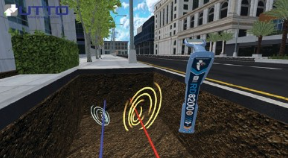
How the Training Simulator Works
Understanding how the system functions is critical for evaluating its real-world value. The goal is not to create a “game,” but to replicate the decision-making process and signal interpretation challenges technicians face in the field.
By combining physical equipment with digital environments, simulators create a highly realistic training experience that mirrors actual locating workflows.
Typical Workflow
Select Training Scenario
Straight line
T-junction
Offset locate
Congested utilities
Simulated Underground Environment
3D digital infrastructure models
Realistic signal behavior
Use a Real Locator
Modified receiver simulates real signals
Mimics actual field responses
Analyze Performance
Accuracy tracking
Decision-making evaluation
Scoring + feedback
What Makes This Different from Traditional Training
Most companies are familiar with traditional training methods, but fewer have experienced how dramatically simulation improves learning outcomes. The difference lies in control, repetition, and feedback.
Instead of relying on chance encounters in the field, simulators intentionally expose technicians to the most important and challenging scenarios.
| Training Method | Limitations | Simulator Advantage |
|---|---|---|
| Field Training | Inconsistent conditions | Fully controlled scenarios |
| Ride-Alongs | Limited repetition | Unlimited practice |
| Classroom Training | No hands-on experience | Interactive, real-world simulation |
| Trial & Error | High risk | Safe-to-fail environment |

Who Should Use a Training Simulator?
Whether you're managing a small crew or a multi-state operation, simulation provides a scalable solution that adapts to your training requirements.
This solution is ideal for:
Utility Contractors
Train new hires faster
- Standardize locating practices
Municipal Utility Departments
Improve internal training programs
Reduce infrastructure damage risk
Private Locating Companies
Scale teams with consistent quality
- Certify technician competency
Pipeline & Infrastructure Companies
Prepare crews for complex environments
Reduce downtime from errors
Training Applications
The true value of a simulator comes from its versatility. It is not limited to basic training. It can support ongoing skill development, advanced scenario training, and specialized workflows.
Organizations can build structured training programs that evolve with technician experience levels, from beginner fundamentals to advanced troubleshooting.
The simulator supports a wide range of real-world scenarios:
Pipe & cable locating fundamentals
Signal tracing & interpretation
Depth estimation training
Cross-bore prevention workflows
Complex urban locating environments
Non-metallic utility challenges
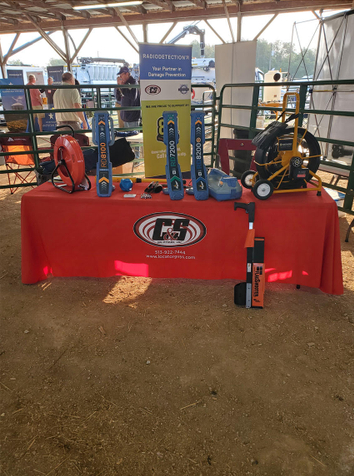
Pairing Training with Real Equipment
Training is most effective when it directly translates to field performance. That’s why simulators are designed to integrate with the same tools technicians use on the job.
This creates a seamless transition from training to fieldwork, ensuring that skills developed in simulation environments carry over immediately.
Training simulators are most effective when paired with:
Pipe & cable locators
Acoustic locating tools (like SonicFinder)
Ground penetrating radar (GPR)
Sewer inspection systems
This creates a complete training-to-field pipeline.

Why Locator Guys for Training Solutions
Choosing the right training solution is not just about the technology. It’s about having the right partner to help implement and scale it effectively.
LocatorGuys understands the challenges of modern utility locating and provides guidance beyond just equipment, helping organizations build stronger, more capable teams.
LocatorGuys doesn’t just sell equipment. We help you build better locating teams.
What You Get:
Expert guidance on training setup
Integration with your existing equipment
Support for scaling training programs
Access to advanced locating technologies